
Hezekiah's Heart
Sermon notes from 1 Kings 18 and beyond!

(Note: There will not be sermon notes for next week, June 28.)
Introduction
Edmond Burke said, “Example is the school of mankind, and they will learn at no other.” We are blessed to have many great examples of faith in the Scriptures to encourage and strengthen us. Paul wrote that stories of Scripture “…occurred as examples to keep us from setting our hearts on evil things as they did.” (1 Corinthians 10:6). One of the greatest examples is King Hezekiah.
Hezekiah was a great king, a great example. Hezekiah ruled Judah during one of the most dangerous periods in its history. The mighty Assyrian Empire was conquering nation after nation. Fear gripped the people. Many advised surrender. Others urged foreign alliances. Yet Hezekiah remained steadfast in his faith and trust in God.
His story becomes even more remarkable when we consider his family background. His father, Ahaz, was one of Judah’s most wicked kings. He worshiped idols and even sacrificed his own son in the fire. His son, Manasseh, followed a similarly wicked path and became one of the most evil rulers Judah ever knew. Yet between those two dark reigns stands Hezekiah—a bright light of faithfulness. His name means ‘Jehovah has strengthened him’.
While Hezekiah was not a perfect man, he was a great King and a great example because his heart belonged to the Lord. I want to share four characteristics that made Hezekiah a great example of faith.
1. Hezekiah Was Wholeheartedly Devoted to God (2 Kings 18:3-4)
2 Kings 18:3-4 (NIV) He did what was right in the eyes of the Lord, just as his father David had done. 4 He removed the high places, smashed the sacred stones and cut down the Asherah poles. He broke into pieces the bronze snake Moses had made, for up to that time the Israelites had been burning incense to it....
Hezekiah’s faith was not a mere profession. It did not consist in intellectual beliefs or empty words. His faith was real and touched every aspect of his entire life.
One of the first things he did as king was remove idolatry from Judah. He destroyed the high places, smashed the sacred stones, cut down the Asherah poles, and even broke apart the bronze serpent Moses had made. That bronze serpent had once been a tool God used to heal His people. But the reminder of God’s grace had become an idol. Even good things can become idols. Sports, entertainment, money, success - all can be good - all can become too important. Hezekiah understood that true devotion requires removing whatever computes with God for our heart.
Hezekiah not only removed idols:
He restored temple worship. (2 Chronicles 29:4-5)
He reinstituted the Passover that had not been properly observed for years.
He called the nation to repentance. (2 Chronicles 30:6-9)
He led a spiritual revival that transformed Judah.
His faith moved him to action. (2 Chronicles 29:3,36)
Hezekiah’s heart for God teaches us the our faith is more than belief - it leads us to obedience, commitment, and action.
2. Hezekiah Trusted God Completely (2 Kings 18:5)
2 Kings 18:5 “Hezekiah trusted in the Lord, the God of Israel. There was no one like him among all the kings of Judah, either before him or after him.”
His trust was tested when the Assyrian army invaded Judah. City after city fell before the mighty forces of King Sennacherib. (2 Kings 18:13) The Assyrian leaders mocked God and Hezekiah (2 KI 18:19-25). They told the people that no god had ever delivered any nation from Assyria and that Judah would be no different. The military odds were overwhelming. The circumstances seemed hopeless. Hezekiah took those threats to the house of God. He prayed, trusted, waited, and God answered (2 Kings 19:14-15). In one night, the Angel of the lord struck down 185,000 Assyrian soldiers (2 Kings 19:35-37).
What a great example of trust. Proverbs 3:5-6 says, “Trust in the Lord with all your heart and lean not on your own understanding; in all your ways submit to him, and he will make your paths straight.” Faith is not trusting God when everything makes sense. Ira Stamphill’s hymn says, “Many things about tomorrow, I don’t seem to understand; But I know who holds tomorrow, And I know who holds my hand.”
3. Hezekiah Remained Faithful (2 Kings 18:6)
2 Kings 18:6 “He held fast to the Lord and did not stop following him; he kept the commands the Lord had given Moses.”
Life can test our grip! Trials come. Disappointments happen. Losses are hard to deal with. Temptations are relentless. It would be easier to quit. But Hezekiah teaches us to hold on to God!
Paul issues a challenge in 1 Corinthians 15:58: “Therefore, my dear brothers and sisters, stand firm. Let nothing move you. Always give yourselves fully to the work of the Lord, because you know that your labor in the Lord is not in vain.”
In all of our struggles and hard times, we must learn to remain faithful to our Lord. He is the only unchanging rock that we can always count on. “Hold to God’s unchanging hand!”
4. Hezekiah Depended on God through Prayer and Godly Counsel (2 Kings 20:1-3; 2 Chronicles 32:20)
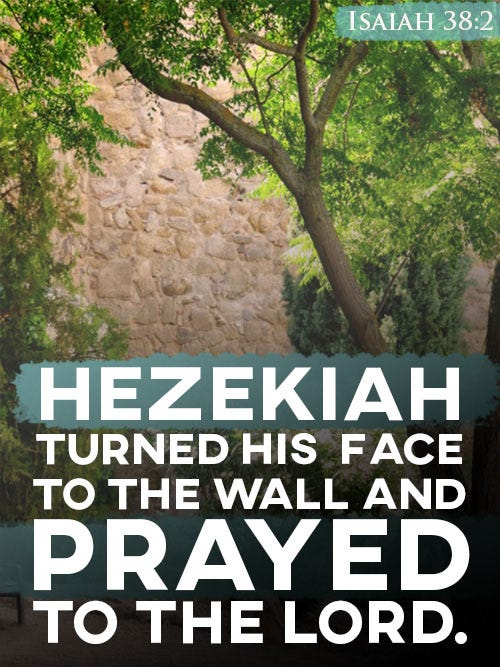
2 Kings 20:1-3 In those days Hezekiah became ill and was at the point of death. The prophet Isaiah son of Amoz went to him and said, “This is what the Lord says: Put your house in order, because you are going to die; you will not recover.” 2 Hezekiah turned his face to the wall and prayed to the Lord, 3 “Remember, Lord, how I have walked before you faithfully and with wholehearted devotion and have done what is good in your eyes.” And Hezekiah wept bitterly.
One of the clearest windows into Hezekiah’s heart is in his prayers. When he became ill, he did what we would expect from a man of faith - he poured out his heart to God. God heard and answered him. God added 15 more years to his life (2 Kings 20:4-6). God confirmed it with a sign - the shadow on the sundial moved backward (2 Kings 20:9-11).
“God hears prayer, God heeds prayer, God answers prayer, and God delivers by prayer. These things cannot be too often repeated. Prayer breaks all bars, dissolves all chains, opens all prisons and widens all straits by which God’s saints have been holden.” —E. M. Bounds
When enemies threatened, he prayed. When illness struck, he prayed. When challenges arose, he prayed. Prayer was not his last resort. Prayer was his first response.
But Hezekiah had another blessing. He surrounded himself with godly influences. The prophet Isaiah served as a counselor, friend, and spiritual guide. Considering the wicked environment in which Hezekiah grew up, Isaiah’s influence was a tremendous blessing.
E. M. Bounds “He was fortunate in having Isaiah for his friend and counselor when he assumed the crown of Judah. How much there is in a ruler’s having a God-fearing man for a counselor and an associate!” This reminds us that no one succeeds spiritually alone. We need faithful friends. We need godly counselors. We need brothers and sisters who encourage us to walk with God.
Great faith is strengthened by prayer and godly companionship.
Conclusion
As we look at Hezekiah’s life, we see a man who was devoted to God, trusted God completely, remained faithful, and depended on God through prayer.
Because of his leadership, worship was restored. The Passover was celebrated. The people were called back to God. The nation experienced spiritual renewal. The Bible summarizes his life this way: “This is what Hezekiah did throughout Judah, doing what was good and right and faithful before the Lord his God. In everything that he undertook in the service of God’s temple and in obedience to the law and the commands, he sought his God and worked wholeheartedly. And so he prospered.” (2 Chronicles 31:20-21)
Yet there is one final lesson.
Even great people have weaknesses. Later in life, Hezekiah allowed pride to enter his heart. After God had blessed him with victory, healing, and prosperity, he became impressed with his own success. “Everybody heard of him. Everybody spoke of him. His cure, his victory, and his wealth were common talk in every place where men met together. What a temptation is this!” wrote Charles Spurgeon. When Babylonian envoys visited Jerusalem, Hezekiah proudly displayed all of his treasures. The Bible says: “But Hezekiah did not respond appropriately to the kindness shown him and he became proud.”
Thankfully, Hezekiah humbled himself and repented (2 Chron 32:26). Even in his failure, Hezekiah’s heart remains an example of faith that we can all follow.

To watch videos of sermons from Forsythe Church of Christ, go HERE.
Our church website is http://facoc.org
To receive sermon notes in your email inbox, subscribe here:

To receive John Dobbs’ newsletter with photographs, books, Christian thoughts, and miscellany, Subscribe Here:

John Dobbs is the author of several books. Find them on Amazon HERE.

Discussion Questions
1. Hezekiah grew up with a wicked father but became a godly king. What does his life teach us about overcoming a difficult family background? How do we break negative family patterns?
2. Hezekiah removed idols that had become accepted parts of the culture. What are some modern idols that Christians often fail to recognize as idols? Why is it sometimes harder to identify good things that have become idols than obviously sinful things?
3. One of Hezekiah’s strengths was that he acted quickly to do what was right. Why do we often delay obedience even when we know what God wants us to do? Can you think of biblical examples where delay caused problems?
4. Hezekiah trusted God when the Assyrian army surrounded Jerusalem. What situations today challenge our trust in God the most? What is the difference between trusting God and simply hoping things will work out?
5. Read Proverbs 3:5-6. Why is trusting God often difficult when circumstances seem to point in another direction? Have you ever seen God work in a situation that looked hopeless?
6. 2 Kings 18:6 says Hezekiah “held fast to the Lord.” What practical habits help believers remain faithful over the long haul? What are some common reasons Christians drift away from God?
7. How would you explain the difference between occasional spiritual enthusiasm and genuine faithfulness? Which biblical characters demonstrate perseverance especially well?
8. When Hezekiah faced a crisis, his first response was prayer. Why do many Christians treat prayer as a last resort instead of a first response? How can we cultivate a more prayer-centered life?
9. Isaiah was a godly counselor and friend to Hezekiah. How important are spiritual friendships in remaining faithful to God? Who has been a significant spiritual influence in your life?
10. Despite all his successes, Hezekiah struggled with pride. Why can spiritual victories sometimes create spiritual dangers? What are some warning signs that pride may be gaining ground in our hearts?
11. Looking at Hezekiah’s life as a whole, which quality do you most want to imitate: devotion, trust, faithfulness, prayerfulness, or humility? Why?
Resources
Amimoro, Samuel. A Character Study of Hezekiah.
Bounds, E. M. Hezekiah the Praying King.
Jackson, Wayne. Hezekiah’s Tunnel.
Myer, F. B. Our Daily Homily.
Spurgeon, C. H. Hezekiah And The Ambassadors—Or, Vainglory Rebuked
